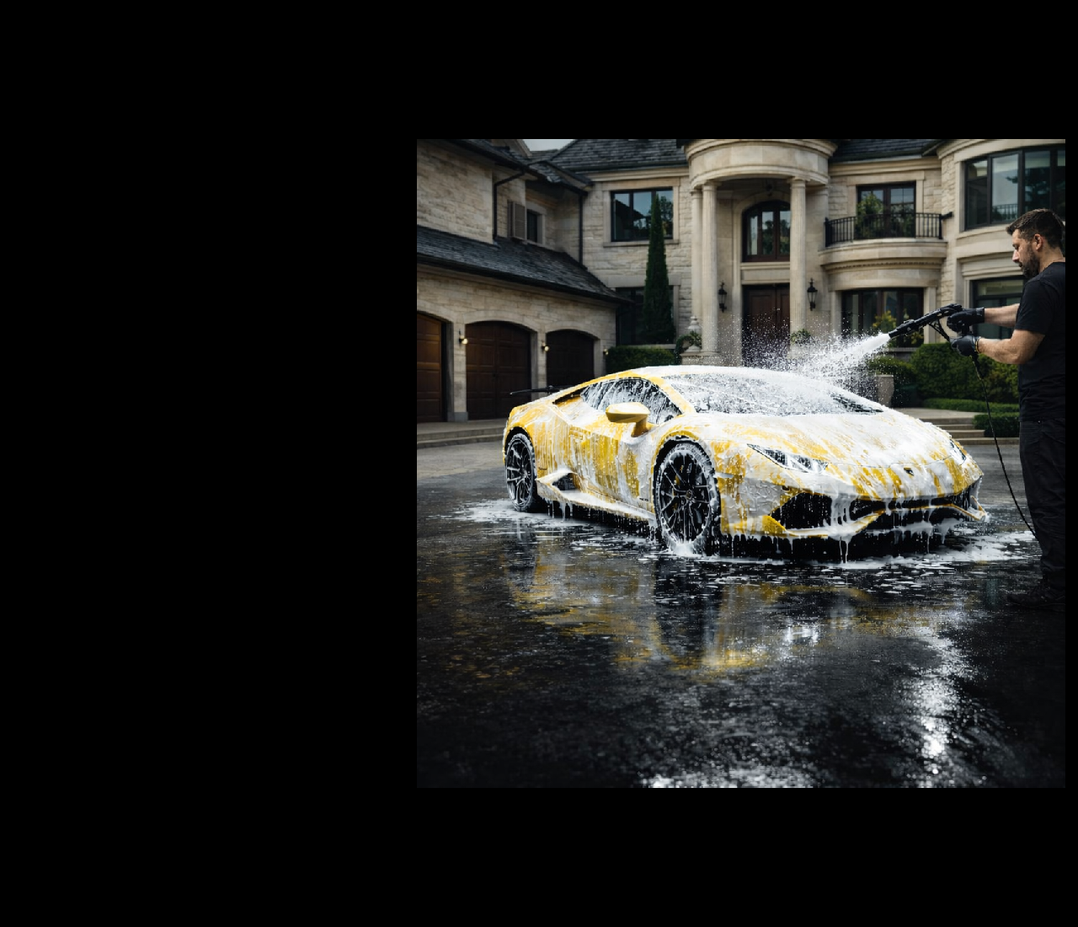
Swirl marks, scratches, and oxidation make even expensive cars look old and neglected. Professional paint correction by Wetsly Detailing restores your paint to better-than-showroom condition.
If you look at your car's paint under direct sunlight or a bright artificial light and see a web of fine circular scratches, those are swirl marks — and they are one of the most common forms of paint damage on vehicles in Rhode Island. Caused by improper washing techniques, automatic car washes, and low-quality detailing products, swirl marks scatter light and make your paint look dull, hazy, and old even on a relatively new vehicle.
Paint correction is the professional process of removing these defects by carefully abrading away a microscopic layer of clear coat to level the surface and eliminate the scratches. When done correctly by a trained technician, the result is paint that looks better than it did when the car left the factory. Wetsly Detailing Auto & Marine provides professional paint correction throughout Rhode Island and Massachusetts. Call us at (401) 362-9364 or find us at 1209 Hartford Ave, Johnston, RI 02919.
Understanding Paint Defects
Not all paint defects are the same, and understanding the difference helps explain why professional correction is necessary.
**Swirl Marks** — Fine, circular scratches that appear as a web pattern under light. Almost always caused by improper washing — automatic car washes, dirty wash mitts, and circular wiping motions are the primary culprits.
**Random Deep Scratches (RDS)** — Deeper, more random scratches caused by keys, branches, shopping carts, or other physical contact. Depending on depth, these may or may not be fully correctable.
**Water Spots** — Mineral deposits left behind when water evaporates on the paint surface. Rhode Island's hard water makes this a common problem. Light water spots can be removed with chemical treatment; severe etching requires polishing.
**Oxidation** — The chalky, faded appearance that develops on older paint or paint that has been left unprotected in the sun. Common on older vehicles and boats. Requires heavy compounding to remove.
**Buffer Trails (Holograms)** — Ironically, these are caused by improper machine polishing. They appear as swirling haze under certain lighting angles and are a sign of an inexperienced detailer.
The Paint Correction Process
Professional paint correction is a multi-stage process that requires significant skill, the right equipment, and a controlled environment.
**Stage 1 — Decontamination:** Before any polishing begins, the paint must be completely clean and free of surface contamination. We perform a thorough wash, followed by clay bar treatment to remove embedded iron particles, tar, and industrial fallout that washing alone cannot remove. This step is critical — polishing over contamination will cause more scratches.
**Stage 2 — Paint Thickness Measurement:** We use a digital paint thickness gauge to measure the clear coat depth at multiple points across the vehicle. This tells us exactly how much material we have to work with and prevents us from cutting through the clear coat.
**Stage 3 — Test Panel:** Before committing to the full vehicle, we perform a test correction on a small, inconspicuous panel to dial in the correct combination of machine speed, pad type, and compound aggressiveness for your specific paint.
**Stage 4 — Compounding (Heavy Correction):** For vehicles with significant defects, we begin with a heavy-cut compound and a cutting pad on a dual-action or rotary polisher. This stage removes the majority of the defects but leaves its own fine micro-marring that must be refined in the next stage.
**Stage 5 — Polishing (Refining):** We follow up with a finer polish and a softer finishing pad to remove the micro-marring left by the compound and bring the paint to a high-gloss, defect-free finish.
**Stage 6 — Protection:** Corrected paint is vulnerable and must be protected immediately. We seal the freshly corrected surface with either a premium carnauba wax, a paint sealant, or a professional ceramic coating for long-term protection.
Why Rhode Island Vehicles Need Paint Correction
Rhode Island's climate creates specific conditions that accelerate paint damage. Road salt used during winter storms is highly corrosive and leaves mineral deposits on paint surfaces. The freeze-thaw cycle causes existing micro-scratches to expand. Automatic car washes — which are extremely common in Rhode Island — use abrasive brushes that create swirl marks with every wash.
The result is that most vehicles in Providence, Johnston, and Cranston that are more than two or three years old have significant paint defects, even if the owners are not aware of it.
Book Your Paint Correction
If your vehicle's paint looks dull, hazy, or covered in swirl marks, Wetsly Detailing can restore it. We provide professional single-stage and multi-stage paint correction throughout Rhode Island and Massachusetts.
Call or text (401) 362-9364 to schedule a consultation. We will assess your paint's condition and provide an honest recommendation for the level of correction your vehicle needs. Follow our paint correction results on Instagram @wetsly_detailing.
READY TO BOOK YOUR DETAIL?
Serving Providence, RI and Massachusetts. We bring the full professional setup directly to your location.
BOOK YOUR DETAIL
Mobile detailing in Providence, RI & Massachusetts. We come to you.
READY TO BOOK YOUR DETAIL?
Serving Providence, RI and Massachusetts — We come to you.
CALL (401) 362-9364